SEMICONDUCTOR DEVICES AND MODELLING LAB
Introduction
Semiconductor devices are the fundamental components of modern electronic circuits and systems, widely used for applications such as amplification, switching, signal processing, and power regulation. Understanding the characteristics and operation of devices like PN junction diodes, Zener diodes, bipolar junction transistors (BJTs), and metal–oxide–semiconductor field-effect transistors (MOSFETs) is essential for students of Electronics and Communication Engineering. The Semiconductor Devices and Modeling Laboratory provides practical exposure to the behavior of these devices through circuit simulation using tools such as LTspice. Simulation-based experiments allow students to analyze device characteristics under different operating conditions, study important phenomena such as temperature effects, Early effect, and channel length modulation, and compare theoretical concepts with simulated results. Through these experiments, students develop a deeper understanding of semiconductor device physics, device modeling, and electronic circuit analysis, which are essential for advanced studies and practical applications in analog electronics and VLSI design.
Course Objectives
| COB-1 |
To impart the basic operation of semiconductor devices. |
| COB-2 |
To impart the knowledge of semiconductor materials. |
| COB-3 |
To study the physics of junction devices and their applications. |
| COB-4 |
To study FET structure and process simulation. |
Course Outcomes
| CO |
Statement |
Bloom’s Level |
| VLSI328P.1 |
Remember and understand the fundamental concepts and basic operation of semiconductor devices. |
Remember, Understand |
| VLSI328P.2 |
Apply semiconductor device principles to explain characteristics and basic applications of devices. |
Apply |
| VLSI328P.3 |
Analyze and evaluate the performance of semiconductor devices. |
Analyze, Evaluate |
| VLSI328P.4 |
Create basic device models or simulation setups to study and validate semiconductor device behaviour. |
Create |
CO-PO-PSO Mapping
| CO |
PO1 |
PO2 |
PO3 |
PO4 |
PO5 |
PO6 |
PO7 |
PO8 |
PO9 |
PO10 |
PO11 |
PO12 |
PSO1 |
PSO2 |
| CO1 |
3 |
2 |
– |
– |
2 |
– |
– |
– |
– |
– |
– |
– |
2 |
1 |
| CO2 |
3 |
3 |
2 |
– |
2 |
– |
– |
– |
– |
– |
– |
– |
3 |
2 |
| CO3 |
3 |
3 |
2 |
2 |
2 |
– |
– |
– |
1 |
1 |
– |
– |
3 |
2 |
| CO4 |
2 |
2 |
3 |
3 |
3 |
– |
– |
– |
2 |
2 |
– |
– |
3 |
3 |
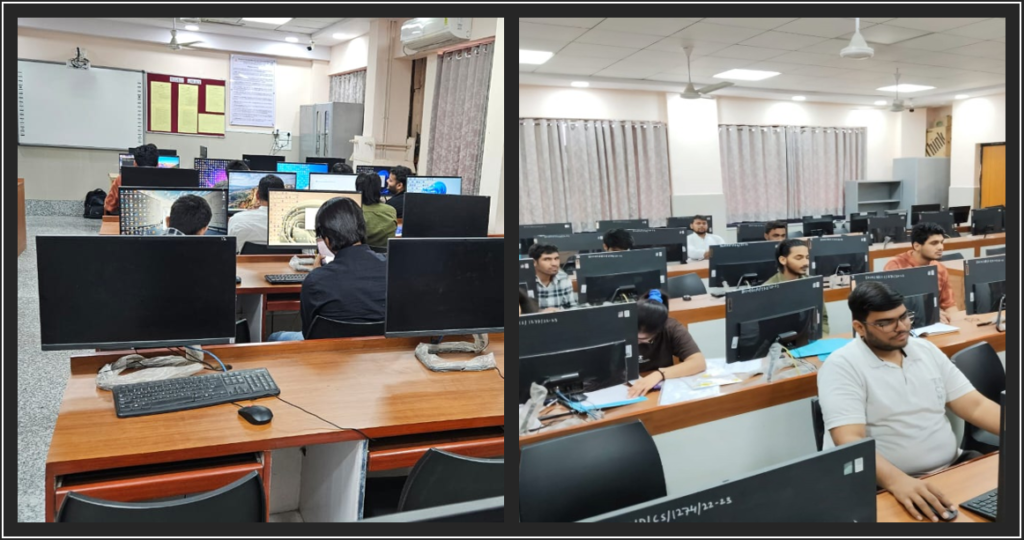 Facilities
Operating System / Software
| Sr. No. |
Name |
Version |
| 1. |
Windows |
10 |
| 2. |
LTSPICE |
|
Hardware
| Sr.No. |
Equipment Name |
Specification |
Quantity |
| 1. |
Computer System |
Intel Core i9 10 Gen 2.10 GH 32 GB RAM |
1 |
| 2. |
Computer System |
Intel Core i5 4 Gen 2.10 GH 16 GB RAM |
2 |
| 3. |
Computer System |
Intel Core i7 8 Gen 3.10 GH 8 GB RAM |
2 |
| 4. |
Computer System |
Intel Core i5 10 Gen 2.10 GH 8 GB RAM |
27 |
| 5. |
Computer System |
GPU System |
1 |
| 6. |
Printer |
HP Laser Jet Pro P1108 |
1 |
Staff
- Lab Incharge: Dr. Priyanka Gupta
- Lab Assistant: Mr. Deepanshu