

DIGITAL COMMUNICATION LAB
Introduction
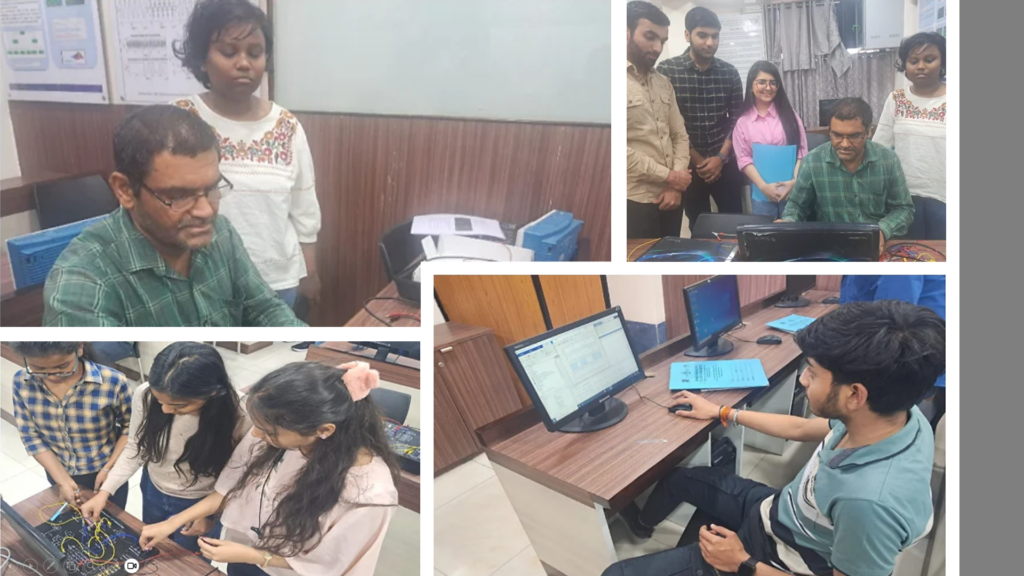
Digital communication plays a crucial role in modern telecommunication systems, enabling efficient, reliable, and high-speed data transmission. This laboratory course provides hands-on experience in key digital modulation and coding techniques, which are fundamental in wireless communication, data networks, and signal processing. The experiments in this lab focus on understanding various digital modulation schemes, line coding techniques, and signal processing algorithms using both hardware implementations and MATLAB simulations.
Course Objectives
| COB-1 | To understand importance of information theory in digital communication and various PCM modulation. |
| COB-2 | To understand the various basic concepts of digital communication. |
| COB-3 | To understand the various digital Modulation-demodulation techniques |
| COB-4 | To understand various coding in digital communications |
Course Outcomes
| CO | Statement | Bloom’s Level |
|---|---|---|
| ECC258.1 | Understand the need of digital communication and creation of digital signals from analog signals. |
Remember, Understand |
| ECC258.2 | Understand and remember the effect of additive white Gaussian Noise on digital communication modulation techniques. |
Understand |
| ECC258.3 | Analyze and apply the effect of inter-symbol interference as the source of channel impairment and the of effect of multipath phenomenon. |
Apply, Analyze |
| ECC258.4 | Apply the principles of communication and design/create communication systems for reliable communication |
Apply, Create |
CO-PO-PSO Mapping
| CO/PO | PO1 | PO2 | PO3 | PO4 | PO5 | PO6 | PO7 | PO8 | PO9 | PO10 | PO11 | PO12 | PSO1 | PSO2 |
|---|---|---|---|---|---|---|---|---|---|---|---|---|---|---|
| ECC258.1 | 3 | 3 | 3 | 3 | 2 | 1 | 1 | – | 2 | 1 | – | 2 | 3 | 3 |
| ECC258.2 | 3 | 3 | 3 | 3 | 2 | 1 | 1 | – | 2 | 1 | – | 2 | 3 | 3 |
| ECC258.3 | 3 | 3 | 3 | 3 | 2 | 1 | 1 | – | 2 | 1 | – | 2 | 3 | 3 |
| ECC258.4 | 3 | 3 | 3 | 3 | 2 | 1 | 1 | – | 2 | 1 | – | 2 | 3 | 3 |
 Facilities
Operating System /Software
| Sr. No. | Name | Version |
|---|---|---|
| 1. | Windows | 10 |
| 2. | MATLAB | 2022B |
Hardware
| Sr.No. | Equipment Name | Specification | Quantity |
|---|---|---|---|
| 1. | Computer | Intel Core (i9) 14900, RAM-32GB | 20 |
| 2. | Computer | Intel Core (i5) 4th Generation 2.90GHz, RAM-16GB | 1 |
| 3. | SAMPLING AND RECONSTRUCTION | MODEL 2151 | 05 |
| 4. | TDM PULSE CODE MODULATION | MODEL 2153 | 07 |
| 5. | TDM PULSE CODE DEMODULATION | MODEL 2154 | 07 |
| 6. | DATA FORMATTING AND CARRIER MODULATION | MODEL 2156 | 05 |
| 7. | DATA FORMATTING AND CARRIER DEMODULATION | MODEL 2157 | 05 |
| 8. | DELTA ADAPTIVE AND DELTA SIGNAL | MODEL 2155 | 02 |
| 9. | DIFFERENTIAL PULSE CODE MODULATION | MODEL 2113 | 05 |
| 10. | QAM TRAINING SYSTEM | MODEL 2136 | 05 |
| 11. | PCM MODU TRANSMITTER | MODEL 2153 | 03 |
| 12. | PAM/PPM/PWM/Trainer | MODEL 2110 | 03 |
| 13. | Digital Oscilloscope | TBS 1052 C50MHZ Dual CHANNEL Oscilloscope | 05 |
| 14. | Printer | HP Laser Jet Pro P1108 Plus | 01 |
Staff
- Lab Incharge: Mr. Jatin Gaur
- Other Faculty Members: Dr. Priyanka Gupta and Dr. S B Kumar
- Lab Assistent: Mr. Rajesh Shukla