

Digital System Design Lab
| Lab Room No. | A-308 |
| Lab In-charge | Dr. Sandeep Banerjee |
| Lab Attendant | Mr. Sachin |
| Lab Subject (Subject Code) | Digital System Design Lab (EEE 338P) |
About the Lab
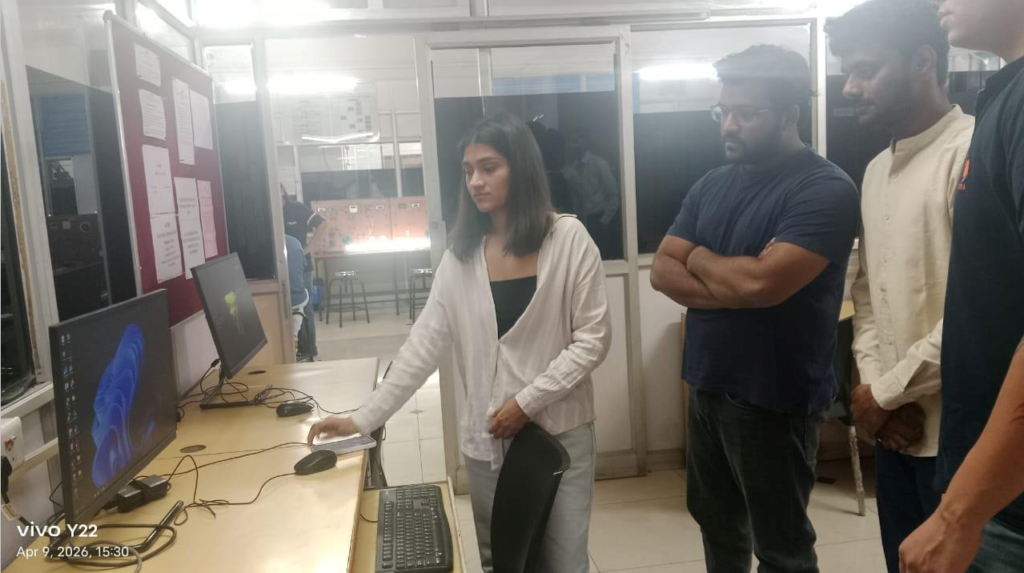
The Digital System Design Laboratory is designed to provide practical knowledge of digital circuit design using VHDL (Very High-Speed Integrated Circuit Hardware Description Language). This laboratory enables students to understand how digital systems are modelled, simulated, and implemented using hardware description languages, thereby bridging the gap between theoretical digital electronics and real-world hardware design.
The primary objective of this lab is to familiarize students with VHDL as a programming and design tool for digital systems. Students learn to apply VHDL in designing both combinational and sequential circuits, along with understanding synchronous and asynchronous system behaviour. The lab emphasizes developing structured coding practices, logical thinking, and the ability to translate circuit designs into hardware description code.
The experiments are organized progressively, starting with the design of basic logic gates using VHDL. This helps students understand fundamental syntax, data types, and simulation processes. As the course progresses, students design combinational circuits such as half adders, full adders, multiplexers, demultiplexers, encoders, decoders, comparators, and code converters. These experiments strengthen the understanding of Boolean logic and combinational circuit implementation using VHDL.
Further experiments focus on sequential circuits such as flip-flops and counters, which introduce the concept of memory elements and clock-based operations. Students learn about synchronous system design, timing behaviour, and state transitions. Additional experiments such as shift registers and seven-segment display design provide insights into practical digital system applications and output interfacing.
The laboratory also highlights the importance of simulation and verification. Students use simulation tools to test and validate their designs, analyze waveforms, and ensure correct functionality before hardware implementation. This process helps in identifying design errors and improving overall system reliability.
Through these experiments, students develop the ability to design, analyze, and implement digital systems efficiently using VHDL. The course outcomes ensure that students gain skills in applying VHDL, designing combinational and sequential circuits, and understanding both synchronous and asynchronous designs.
Overall, this laboratory plays a significant role in preparing students for advanced fields such as VLSI design, FPGA-based system development, embedded systems, and digital hardware design. It enhances both programming and hardware design skills, making it an essential part of modern electronics engineering education.
 List of Experiments
| Sr. No. | Experiment |
|---|---|
| 1 | Design all gates using VHDL. |
| 2 | Design a half adder/full adder using VHDL. |
| 3 | Design a multiplexer/demultiplexer using VHDL. |
| 4 | Design a decoder/encoder using VHDL. |
| 5 | Design a comparator using VHDL. |
| 6 | Design a code converter using VHDL. |
| 7 | Design a flip-flop using VHDL. |
| 8 | Design a counter using VHDL. |
| 9 | Design a shift register using VHDL. |
| 10 | Design a seven-segment display using VHDL. |