
Introduction
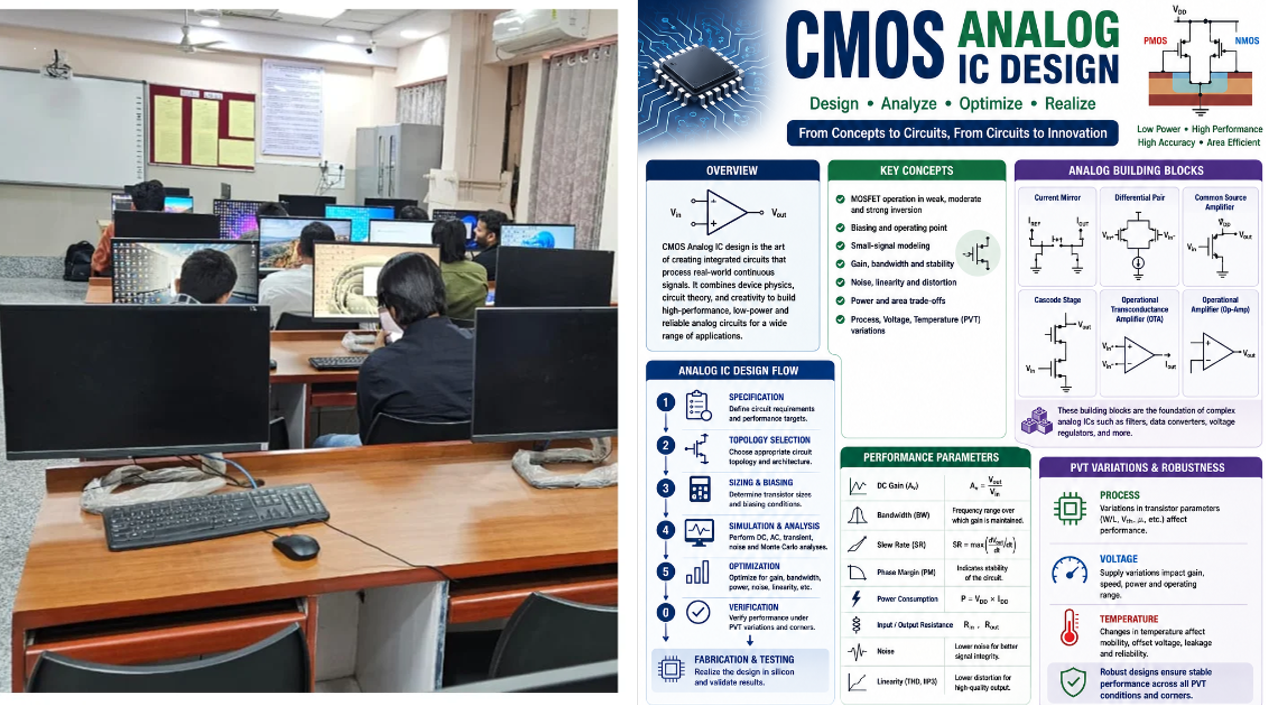
CMOS Analog Integrated Circuit Design Lab provides practical exposure to the design, simulation, and analysis of analog circuits using CMOS technology. The laboratory helps students understand how basic MOSFET characteristics and analog building blocks are used to develop integrated circuits with desired performance. Circuit design and verification are performed using Tanner EDA tool, where students learn to develop schematics/netlisting, select appropriate transistor dimensions and biasing conditions, perform AC/DC/transient analyses, and evaluate the effect of different parameters.
The laboratory aims to bridge the gap between theoretical concepts and practical circuit design. It also develops students’ skills in circuit optimization, performance evaluation, troubleshooting, and understanding the design trade-offs involved in low-power and high-performance CMOS analog integrated circuits.
Course Objective
- To impart the knowledge of basic MOS device Physics, low and high frequency analog MOSFET modelling.
- To provide the concepts of Single Stage and Differential amplifiers and their analysis.
- To provide the concepts of active and passive current mirrors, large signal analysis, small signal analysis and frequency response of amplifiers.
- To provide the concepts of feedback circuits, their topologies, operational amplifier and oscillators.
Course Outcomes
| CO | Statement | Bloom’s Level |
|---|---|---|
| CO1 | To understand the basics of MOS device and its low and high frequency modelling. | Remember, Understand |
| CO2 | To understand the concepts of Single Stage and Differential amplifiers and their analysis. | Analyze |
| CO3 | To understand the concepts of current mirrors, large signal analysis, small signal analysis and frequency response of amplifiers. | Analyze, Evaluate |
| CO4 | To understand the concepts of feedback circuits, their topologies, operational amplifier and oscillators. | Apply, Create |
CO-PO-PSO Mapping
| CO | PO1 | PO2 | PO3 | PO4 | PO5 | PO6 | PO7 | PO8 | PO9 | PO10 | PO11 | PSO1 | PSO2 |
|---|---|---|---|---|---|---|---|---|---|---|---|---|---|
| CO1 | 2 | 2 | 3 | 3 | 2 | 2 | — | 1 | 2 | 3 | 3 | 3 | — |
| CO2 | 3 | 2 | 3 | 3 | 3 | 2 | — | 1 | 2 | 3 | 3 | 3 | — |
| CO3 | 3 | 2 | 3 | 3 | 3 | 2 | — | 1 | 2 | 3 | 3 | 3 | — |
| CO4 | 3 | 2 | 3 | 3 | 3 | 2 | — | 1 | 2 | 3 | 3 | 3 | — |
 Facilities
Operating System / Software
| Sr. No. | Name | Version |
|---|---|---|
| 1. | Windows | 10 |
| 2. | Mentographics Tanner (HEP-1) & (HEP-2) | — |
Hardware
| Sr. No. | Equipment Name | Specification | Quantity |
|---|---|---|---|
| 1. | Computer System | Intel Core i9, 10th Gen, 2.10 GHz, 32 GB RAM | 1 |
| 2. | Computer System | Intel Core i5, 4th Gen, 2.10 GHz, 16 GB RAM | 2 |
| 3. | Computer System | Intel Core i7, 8th Gen, 3.10 GHz, 8 GB RAM | 2 |
| 4. | Computer System | Intel Core i5, 10th Gen, 2.10 GHz, 8 GB RAM | 27 |
| 5. | Computer System | GPU System | 1 |
| 6. | Printer | HP LaserJet Pro P1108 | 1 |
Staff
- Lab Incharge: Dr. Annu Dabas
- Lab Assistant: Mr. Rajesh Shukla