
Utilization of Electrical Energy Lab
| Lab Room No. | A-307 |
| Lab In-charge | Dr. Sandeep Banerjee |
| Lab Attendant | Mr. Prem Singh |
| Lab Subject (Subject Code) | UEE Lab (EEE 320P) |
About the Lab
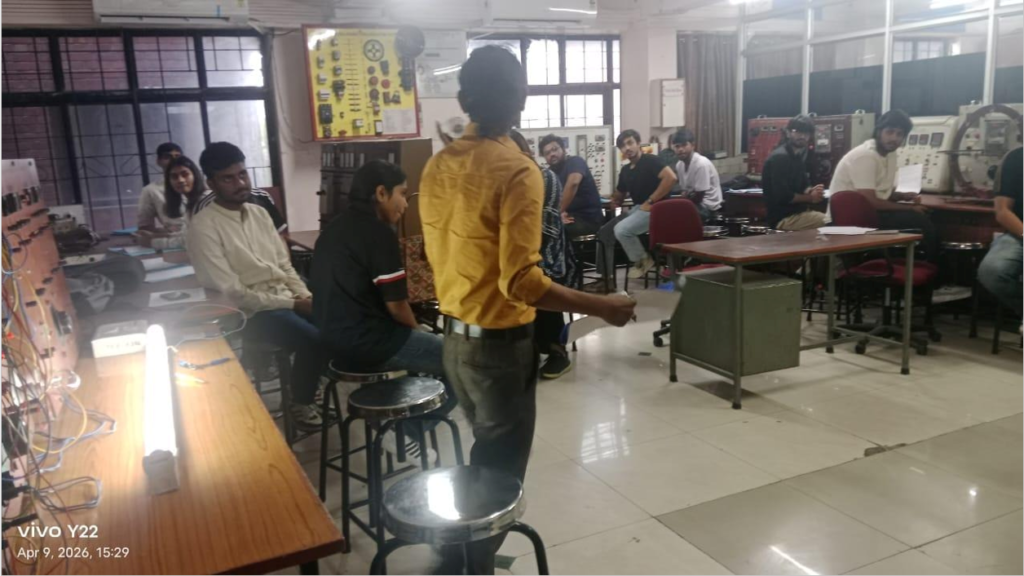
The Utilization of Electrical Energy Laboratory is designed to provide practical knowledge of how electrical energy is effectively used in various applications such as lighting, heating, motor operation, and braking systems. This lab helps students understand real-world applications of electrical engineering concepts by combining theoretical knowledge with hands-on experiments and simulations.
The primary objective of this laboratory is to familiarize students with different electrical devices and systems used in energy utilization. Students learn to operate various lighting systems such as CFLs, LEDs, and incandescent lamps, and analyze their performance characteristics. The lab also introduces heating and welding applications, enabling students to understand how electrical energy is converted into heat for practical industrial use.
The experiments are structured to cover a wide range of applications. Initial experiments include studying lighting characteristics, plotting polar curves for different lamps, and verifying the inverse square law of light. These experiments help students understand illumination concepts and light distribution patterns.
Further experiments focus on electrical machines and energy conversion systems. Students study the plugging and dynamic braking of three-phase induction motors using MATLAB Simulink, which provides insights into motor control and braking techniques. Additionally, they analyze the performance characteristics of DC series motors by plotting relationships between armature current, speed, and torque, which strengthens their understanding of machine behaviour.
The laboratory also includes experiments related to transformers, such as measuring the turns ratio and testing the dielectric strength of transformer oil. These experiments highlight the importance of insulation, safety, and efficiency in power systems.
Additional practical exercises include checking ceiling fan windings to identify faults and determine correct connections, as well as studying the wiring and operation of fluorescent tube lighting systems. These experiments enhance students’ practical troubleshooting skills and understanding of everyday electrical appliances.
An important aspect of this lab is the integration of simulation tools like MATLAB Simulink along with hardware-based experiments. This combination allows students to visualize system behaviour, validate theoretical concepts, and gain confidence in analyzing electrical systems.
Overall, this laboratory plays a crucial role in developing practical skills, analytical thinking, and problem-solving abilities related to the utilization of electrical energy. It prepares students for real-world applications in areas such as electrical installations, energy management, motor control, and industrial systems.
 Hardware Details
| Sr. No. | Equipment |
|---|---|
| 1 | Illumination Test Bench |
| 2 | Lux Meter |
| 3 | CFL |
| 4 | LED |
| 5 | Steel Bar |
| 6 | Electromagnet |
| 7 | Transformer |
| 8 | Ceiling Fan |
| 9 | Fluorescent Tube |
Software Details
- MATLAB
List of Experiments
| Sr. No. | Experiment |
|---|---|
| 1 | To study the plugging of a three-phase induction motor using MATLAB Simulink. |
| 2 | To plot polar curves for various lamps. |
| 3 | To prove the inverse square law of light. |
| 4 | Measurement of Iron losses in a given bar specification. |
| 5 | To study the DC dynamic braking of a three-phase induction motor using MATLAB Simulink. |
| 6 | Measurement of Transformer Turns Ratio. |
| 7 | Testing of Dielectric Strength of Transformer Oil. |
| 8 | To obtain the characteristic curves [Armature current (Ia) vs Speed (W), Armature Current (Ia) vs Torque (T), and Speed (W) vs Torque (T)] for D.C. Series Motor. |
| 9 | To check the windings of a ceiling fan for faults and detect the main winding, auxiliary winding, and common terminals for proper capacitor connection. |
| 10 | To study the wiring diagram of a fluorescent tube and test the main components. |