

Introduction
Wireless Sensor Networks (WSNs) consist of spatially distributed, small, low-cost battery-powered devices (nodes) that monitor physical or environmental conditions—such as temperature, sound, or pressure—and cooperatively pass their data through a network to a central base station. They are characterized by wireless communication, limited energy, and high reliability, making them ideal for surveillance, environmental monitoring, and industrial automation. We perform all the experiments as per the curriculum on NS 3.28.1 open source software.
Course Objectives
| COB-1 | To make students understand the basics of Wireless sensor Networks. |
| COB-2 | To familiarize with learning of the Architecture of WSN. |
| COB-3 | To familiarize with learning of the Architecture of WSN. |
| COB-4 | To study the design consideration of topology control and solution to the various problems. |
Course Outcomes
| CO | Statement | Bloom’s Level |
| ECC359.1 | Understand challenges and technologies for wireless networks. | Understand |
| ECC359.2 | Understand architecture and sensors. | Understand |
| ECC359.3 | Describe the communication, energy efficiency, computing, storage and transmission. | Evaluate, Analyze |
| ECC359.4 | Explain the concept of programming the in WSN environment. | Apply |
CO-PO-PSO Mapping
| CO/PO | PO1 | PO2 | PO3 | PO4 | PO5 | PO6 | PO7 | PO8 | PO9 | PO10 | PO11 | PO12 | PSO1 | PSO2 |
| ECC359.1 | 3 | 2 | 2 | 1 | 2 | 1 | – | – | – | – | 3 | 3 | 2 | 2 |
| ECC359.2 | 3 | 2 | 2 | 1 | 2 | 1 | – | – | – | – | 3 | 3 | 2 | 2 |
| ECC359.3 | 3 | 2 | 2 | 1 | 2 | 1 | – | – | – | – | 3 | 3 | 2 | 2 |
| ECC359.4 | 3 | 2 | 2 | 1 | 2 | 1 | – | – | – | – | 3 | 3 | 2 | 2 |
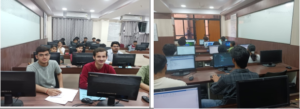
Facilities
| Operating System /Software | ||
| Sr. No. | Name | Version |
| 1. | UBUNTU | |
| 2. | NS 3 | NS 3.28.1 |
| Hardware | |||
| Sr.No. | Equipment Name | Specification | Quantity |
| 1. | Computer | Intel Core i5-3330S, 2.70 GHz, 4th generation, 16 GB RAM | 20 |
| 2. | Printer | HP Laser Jet 1020 Plus | 01 |
| 3. | Smart Digital Board | Senses edge | 01 |
Staff
- Lab Incharge: Mr. Sourabh Rana
- Other Faculty Members: Dr.Surjeet Balhara, Dr. Monica Bhutani
- Lab Assistent: Mrs. Deepa Bhatia