

Introduction
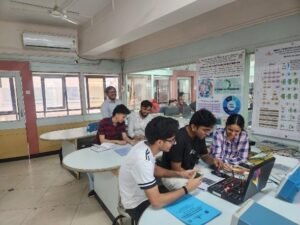
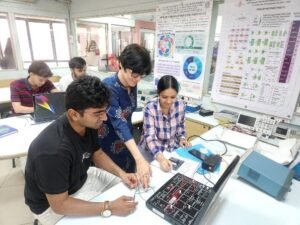
The Optical Communication Systems and Networks (OCSN) Lab is equipped with state-of-the-art hardware and advanced simulation tools to provide a comprehensive learning and research environment in optical fiber communication, signal processing, and photonics. The lab features SCIENTECH Fiber Optics Trainer Kits, TDM Trainers, Optical Power Meters, TEKTRONIX Digital Storage Oscilloscopes, and Arbitrary Function Generators, enabling hands-on experience in optical signal transmission, multiplexing, and network analysis.
In addition to hardware, the lab is upgraded with OptiSystem 23, a cutting-edge optical communication system design software that enhances research capabilities. OptiSystem 23 is an advanced optical communication system simulation software that enhances the capabilities of the OCSN Lab by enabling the design, analysis, and optimization of next-generation fiber optic networks. It supports WDM, SDM, and FSO systems, integrates AI and machine learning for performance optimization, and includes models for 5G optical backhaul and quantum communication. With an expanded component library, coherent optical system simulation, and MATLAB/Python integration, it facilitates cutting-edge research in photonic circuits, hybrid optical-wireless technologies, and AI-driven network management. Its high-speed computational performance and real-world system modeling align with industry advancements, preparing students for careers in modern optical networking.
Course Objectives
| COB-1 | To impart the knowledge of optical communication and propagation of light through physical medium. |
| COB-2 | To impart the knowledge about optical fibers, propagation of light through them and signal degradation during signal propagation through optical fibers. |
| COB-3 | Let the students understand about the types, construction, working, and characteristics of various optical sources. |
| COB-4 | Let the students know about the types, construction, and working of various optical detectors and also know about basic optical receivers. Students should also know about basic optical networks. |
Course Outcomes
| CO | Statement | Bloom’s Level |
| ECE 326.1 | To understand the optical communication and propagation of light through physical medium.
|
Remember, Understand |
| ECE 326.2 | To understand various types of optical fibers, propagation of light through them and able to analyse
signal degradation in optical fibers. |
Analyse, Apply |
| ECE 326.3 | To understand various optical sources and use them in optical transmitting systems. | Evaluate |
| ECE 326.4 | To understand various optical detectors and apply them in optical receivers and Analyze various
optical networks. |
Create |
CO-PO-PSO Mapping
| CO/PO | PO1 | PO2 | PO3 | PO4 | PO5 | PO6 | PO7 | PO8 | PO9 | PO10 | PO11 | PO12 | PSO1 | PSO2 |
| ECE 326.1 | 3 | 3 | 2 | 2 | 2 | 2 | 1 | 1 | 2 | 1 | 2 | 2 | 2 | |
| ECE 326.2 | 3 | 3 | 2 | 2 | 2 | 2 | 1 | 1 | 2 | 1 | 2 | 2 | 2 | |
| ECE 326.3 | 3 | 3 | 2 | 2 | 2 | 2 | 1 | 1 | 2 | 1 | 2 | 2 | 2 | |
| ECE 326.4 | 3 | 3 | 2 | 2 | 2 | 2 | 1 | 1 | 2 | 1 | 2 | 2 | 2 |
Facilities
| Operating System /Software | ||
| Sr. No. | Name | Version |
| 1. | Windows | 10 |
| 2. | OptiSystem 23.0 (7 user Licensed) | 23.0 |
| Hardware | |||
| Sr.No. | Equipment Name | Specification | Quantity |
| 1. | Computer | Intel Core (i7) 14900, RAM-32GB, 3.20 GHz | 07 |
| 2. | Computer | Intel Core (i5) 4th Generation 2.90 GHz, RAM-16GB | 4 |
| 3. | SCIENTECH Fiber Optics Trainer Kit | Model 2501A | 03 |
| 4. | SCIENTECH Optical Power Meter | Model 2551A | 02 |
| 5. | SCIENTECH TDM Trainer | Model 2503 | 02 |
| 6. | TEKTRONIX Digital Storage Oscilloscope | Model TBS1052C | 02 |
| 7. | TEKTRONIX Arbitrary Function Generator | AFG1022 | 07 |
| 8. | Printer | HP Laser Jet Pro P1108 Plus | 01 |
Staff
- Lab Incharge: Dr. Rubeena Vohra
- Other Faculty Members: Dr. Yugnanda and Dr. Parashuram
- Lab Assistent: Mr. Aniket Pawar