

Microprocessor and Microcontroller Lab
| Lab Room No. | A-304 |
| Lab In-charge | Dr. Neeraj Kumar |
| Lab Attendant | Mr. Prem |
| Lab Subject (Subject Code) | MPMC Lab (ECC 363) |
About Lab
The Microprocessor and Microcontroller Laboratory (ECC 363) is designed to provide practical exposure to microprocessor systems, specifically the 8085 and 8086. It bridges the gap between theoretical knowledge and real-world implementation by enabling students to write, execute, and analyze assembly-language programs using training kits. This lab helps in developing a strong foundation in low-level programming and system-level understanding.
The main objective of this laboratory is to enable students to apply concepts learned in the microprocessor course to solve practical problems efficiently. Students learn to write structured, optimized programs using proper mnemonics while ensuring effective use of hardware resources. The lab also enhances analytical skills by encouraging debugging, step-by-step execution, and troubleshooting of both software and hardware-related issues.
The experiments are designed progressively, starting with basic arithmetic operations such as addition and subtraction of 8-bit and 16-bit numbers. These experiments help in understanding register operations, instruction execution, and the role of flag registers. As students progress, they work on array-based problems such as finding the largest element and sorting data in ascending or descending order, which improves logical thinking and algorithm design.
Further experiments include decimal addition, handling multiple data inputs, and storing results at specific memory locations. Advanced tasks such as string sorting and 2’s complement conversion expose students to real-world data processing and memory handling techniques.
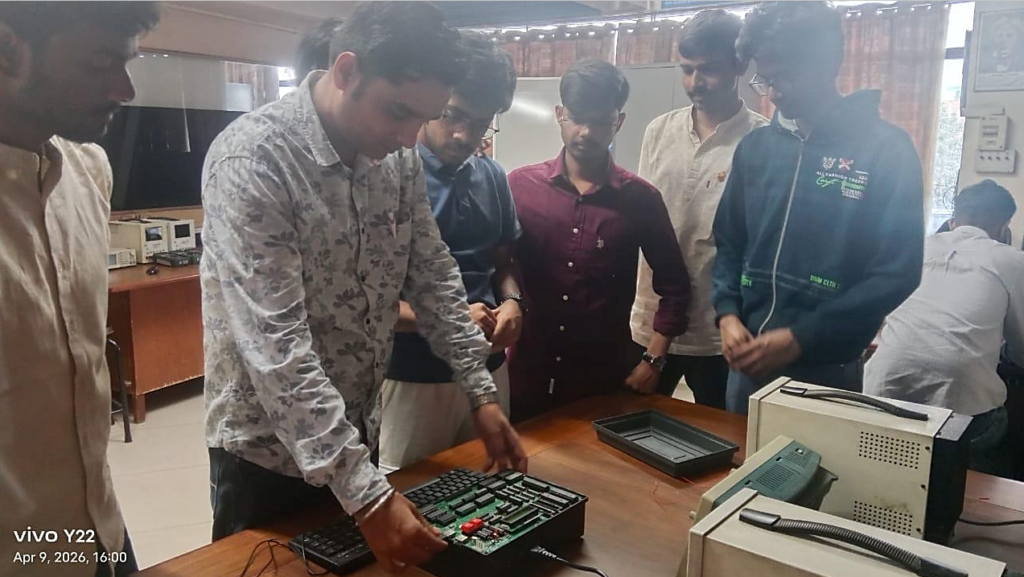
A key aspect of this lab is the execution of programs on training boards, which provides hands-on experience with real-time system behaviour. Students gain practical knowledge of program loading, execution, and output verification, along with an understanding of hardware constraints.
Overall, this laboratory plays an important role in developing problem-solving abilities, programming efficiency, and practical knowledge of microprocessor systems. It prepares students for applications in embedded systems, control systems, and hardware-software integration.
 Hardware Details
| Sr. No. | Equipment | Quantity |
|---|---|---|
| 1 | Microprocessor Kit 8086 (Advanced Version) | 16 |
| 2 | Interfacing Modules (8255, 8253, Stepper Module) | — |
| 3 | Computers (i5 Processor, 4 GB RAM, 500 GB Hard Disk) | 2 |
List of Experiments
| Sr. No. | Experiment |
|---|---|
| 1 | To add two 8-bit numbers using 8085/8086. |
| 2 | To add two 16-bit numbers (i) with carry (ii) without carry, using 8085/8086. |
| 3 | To write a program to subtract two 8-bit numbers using 8085/8086. |
| 4 | To find the largest number in a given array using 8085/8086. |
| 5 | To arrange the contents of an array in ascending or descending order using 8085/8086. |
| 6 | To implement the decimal addition of two 8-bit numbers using 8085/8086. |
| 7 | To add five 8-bit numbers with the other five 8-bit numbers and store the result at the given locations using the 8086. |
| 8 | To find the largest number in an array and store the result at a given location using 8086. |
| 9 | To sort a string of a number of bytes in descending order using 8086. |
| 10 | To convert a data string into its equivalent 2’s complement using 8086. |