
Power Electronics Lab
| Lab Room No. | A-303 |
| Lab In-charge | Dr. Sandeep Banerjee |
| Lab Assistant | Mr. Prem Singh |
| Lab Subject (Subject Code) | Power Electronics (EEC-357) |
About the Lab
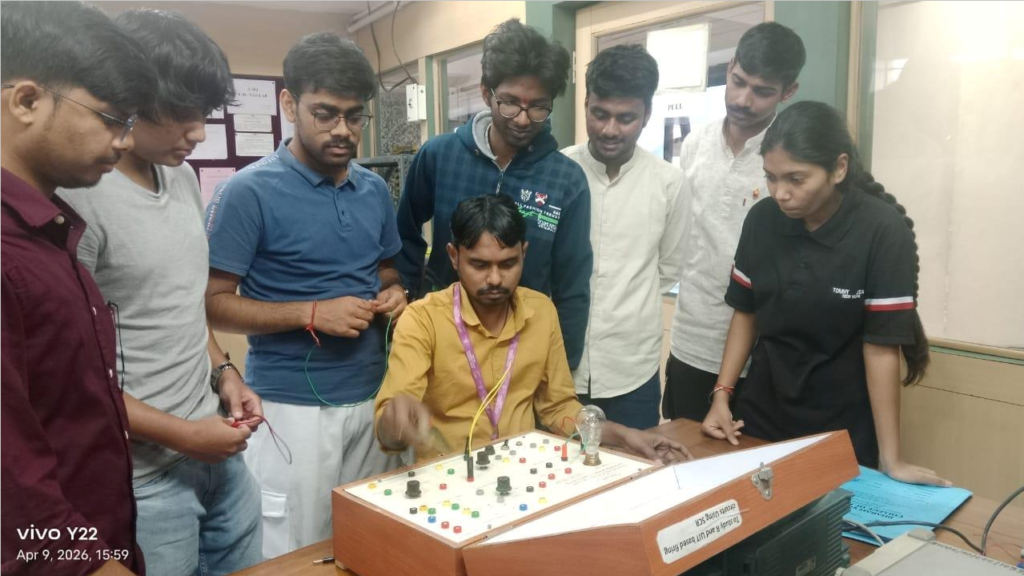
The Power Electronics Laboratory (EEC 357) is designed to provide a practical understanding of power semiconductor devices and their applications in power conversion systems. This laboratory enables students to bridge the gap between theoretical concepts and real-world implementation by performing experiments on various power electronic circuits and simulation platforms. It plays a vital role in developing hands-on skills related to switching devices, converters, and control techniques.
The primary objective of this lab is to familiarize students with the operation and characteristics of power semiconductor devices such as SCR, TRIAC, MOSFET, and IGBT. Students learn how to operate these devices, analyze their switching behaviour, and understand their role in controlling electrical power. The lab also focuses on implementing controlled rectification and chopper circuits to regulate voltage and control the speed of DC motors.
The experiments are structured progressively, beginning with the study of switching characteristics of SCR/TRIAC and MOSFET/IGBT devices. Students gain insights into triggering methods, switching conditions, and device behaviour under different operating conditions. Further, firing circuits using R, RC, and UJT are studied to understand how controlled triggering of SCRs is achieved in practical applications.
As students advance, they work on converter circuits such as single-phase semi-converters and full converters feeding resistive and inductive loads. These experiments help in understanding phase control techniques, waveform analysis, and the impact of load types on output performance. AC phase control using DIAC and TRIAC is also studied, which is widely used in applications like light dimmers and speed control of fans.
The laboratory also includes experiments on chopper circuits, specifically Type-C choppers, where students study duty cycle control and its effect on output voltage. In addition, inverter circuits such as single-phase full bridge square wave inverters are analyzed to understand DC to AC conversion. Simulation-based experiments like cycloconverters and multi-level inverters further enhance understanding of advanced power electronic systems.
Additional experiments include simulation of three-phase Voltage Source Inverters (VSI) and three-level DCMLI, where students observe output waveforms and analyze the number of voltage levels based on switching schemes. These experiments help in developing analytical skills and understanding modern converter topologies.
An important aspect of this lab is the use of both hardware setups and simulation tools, allowing students to visualize real-time waveforms and validate theoretical concepts. This hands-on exposure enhances their ability to design, analyze, and implement power electronic circuits effectively.
Overall, the Power Electronics Laboratory equips students with essential knowledge and practical skills required for applications in electric drives, renewable energy systems, motor control, and industrial automation. It also prepares them for advanced studies and professional roles in power electronics and related fields.
 Hardware Details
| Sr. No. | Equipment |
|---|---|
| 1 | SCR & TRIAC Kit |
| 2 | MOSFET Kit |
| 3 | UJT Kit |
| 4 | Single Phase HWR Kit |
| 5 | Single Phase Fully Controlled Rectifier Kit |
| 6 | AC Phase Control Kit |
| 7 | Cycloconverter Kit |
| 8 | Type-C Chopper and SPWM Inverter Kit |
| 9 | Computers (i5 Processor, 4/8 GB RAM) |
Software Details
- MATLAB
List of Experiments
| Sr. No. | Experiment |
|---|---|
| 1 | To study and analyse the switching operation of SCR/TRIAC. |
| 2 | To study and analyse the switching operation of MOSFET/IGBT. |
| 3 | To study R/RC/UJT-based firing circuits for SCR. |
| 4 | To study single-phase semi-converters/full converters feeding R/RL load. |
| 5 | To study A.C. phase control using DIAC and TRIAC. |
| 6 | To simulate a single-phase step-down Bridge Type Cycloconverter feeding R/RL load. |
| 7 | To study the operation and duty cycle control of the Type-C chopper. |
| 8 | To simulate the operation of a single-phase full-bridge square-wave inverter. |
| 9 | To simulate a three-phase VSI and observe its line voltage and phase voltage for 180-degree operation. |
| 10 | To simulate a single-phase three-level DCMLI. |